HOW POSTURE THERAPY WORKS
I had a client the other day that came in with major pain and I thought I would share his story with you because this visit clearly illustrates how posture therapy works.
“Tom” came to us with left knee pain. He had tried all kinds of things to help it – yoga, massage, stretching, chiropractic, physical therapy, even medication. Nothing seemed to help and often his knee hurt as much if not more after these activities.
The focus of our posture work is looking at the body as a unit, as a complete system. Most people think the problem is where the pain is, but that is hardly ever the case. Tom’s pain tells us there is an issue with his left knee, but the cause of that knee pain is most likely somewhere else. How do we find out where the root of the pain is? Let me take you through our thought process as Posture Alignment Specialists certified by Egoscue University.
As I said before, we look at the body as a unit, without focusing on the symptom (Tom’s knee pain). I look at him to see if his ankles, knees, hips and shoulders line up in straight lines and at ninety degree angles. I’m not thinking about what I can give him to make his knee feel better but I ask myself how is his body working as a unit?
Looking at Tom, the first thing that jumped out at me was that his right hip was an inch higher than the left. Viewing from the front or back, his right hip was definitely elevated. Just standing there, I could see that he did not really put equal weight on his right side. With a hip that is elevated, it is so out of position that it is unable to do its job taking equal weight.
As a little test, I asked him to stand on one leg at a time, bending the other and bringing it up waist high. Standing on his left side, the painful one, he could balance easily, but he could not balance standing on his right side. So, I’m thinking that hip elevation is probably the major cause of his left knee pain, but I want to watch him walk first. When he walks across the room and back I can see that he definitely shifts more onto his left side. When I ask him if he can feel that he lands harder on his left side, his answer was “yeah, sort of” but when I have him watch himself walk in the mirror, he sees it clearly.
It’s a little strange that he shifts onto his painful side. Most people shift away from the painful side. Tom agrees that it doesn’t make any sense to him and has no idea why he would do that. I explain that with his right hip so out of position, he simply is unable to load his weight equally from left to right.
So, Tom’s thought was “If my left knee hurts because my right hip is elevated, I’ll do some hip exercises to even them out and we’re good, right?” “Hang on” I explained, “Let’s figure out why that hip is elevated. Maybe that hip is the problem, but there could be something else going on.”
Often what we see in the clinic is that the client’s upper body position has a huge effect on the ability of the lower body to work properly. When I look at Tom from his side views, I see his head way forward, his shoulders hinged forward and his upper body rounded over. He looks like a big “C”. Tom’s spine should have three little curves in a gradual “S” shape, not a big “C”. I put my hands on the top of each side of his pelvis to confirm that his right hip is higher and leaving my hands there I have Tom interlace his fingers together and put his hands behind his head and pull his elbows back as hard as he can. He grimaces as if this is a bit difficult, then jokes about the only other time he did this, he was talking to a police officer! But, guess what, with his hands up like that his hips become even. I have him walk across the room again keeping his hands behind his head and elbows back and as he does that his hips stay level and load equally from left to right. The hip disparity is gone and he can see it for himself as he walks toward the mirror. He is amazed.
He laughs, “so all I have to do is walk around like this the rest of my life?” I said “yeah, and in your neighborhood, they’d think nothing of it!!” In all seriousness though, we have to get Tom’s upper body in that position without him having to put his hands up to get there. I could see that Tom got it.
Putting his hands behind his head took his upper back that was stuck in flexion and shoulders that rounded forward and got them into a more extended position, closer to where the body was designed to be. In this position the rest of his body changed and we could see his hips were level and his walking become equal left to right.
Bottom line: Tom’s left knee hurts because every step he takes, he makes it work harder than it’s supposed to by putting more weight on it than it should normally get. Along with that, as he keeps loading that left hip more and more, it gets tighter and tighter and over time stops rotating the way it should, so then the knee has to take up that job. The knee was never designed to rotate – it’s a hinge. So he’s not only putting more weight on that side with every step, he’s asking his left knee to do something it was never designed to do — rotate! That knee is working like crazy taking more weight and twisting with every step – one hard step off a curb and the ACL tears – ouch!!!
Because the right hip is out of position he cannot load evenly left to right. The right hip is out of position because his upper body is pulling it there. In order to resolve the knee pain we have to get his upper body and shoulders in a more extended upright position.
All the other people trying to help him were only seeing his knee as the problem and so focused on the knee. But the cause of his knee pain symptom was not the knee but the position of his upper body. He could have done and did all kinds of things for his knee (the symptom) nothing changed because the cause of that symptom was not addressed. We gave him a sequence of exercises to get the upper body more extended and some others to help the hip change position and stabilize so by the end of our session he felt better and walked better than he had in years.
This is not the end of the story. In fact, it’s just a beginning. Tom has to do his exercises every day to retrain his body so it will live in the better position. It’s not a quick fix, but if he does the work, he will begin to stay in that better position and he won’t have knee pain.
Where you are having pain (symptom) is rarely the actual cause of the problem. The body works as a unit. When we observe and treat the whole body as a unit the results can be amazing; some people have said miraculous. It’s not so much a miracle, it’s just returning to the body’s original design of straight lines and 90 degree angles. If you would like some help getting your body back to this basic design, give us a call or check out our website.
If you can understand these simple concepts, you don’t have to live with or be afraid of pain. Pain is just a message that something is wrong and your body is asking for help. Instead of ignoring it, let’s listen and then respond to it with grace and intelligence. Believe in your body and honor it by giving it the motion it needs and the results can be truly amazing.
MACKIE BOBLETTE
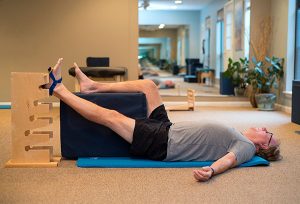 The TOWER, as we affectionately call it, is truly an amazing piece of equipment. It may look menacing but it should not be feared! The tower helps to re-establish the functional chain reaction of muscles that we need in order to maintain good posture and be pain free. It’s great because you just lie there and better posture happens just by lowering the leg through different positions! Yes, it takes time to do it. Because most of us don’t think anything is happening unless we’re DO-ing something, one might be skeptical that anything could be changing. Just because you aren’t actively doing something doesn’t mean that the body is inactive. In the tower the body is actually very active while you just lay there! Really. For the musculoskeletal system, it’s like going on a long walk with everything working right — without any of your habitual compensations allowed to come into play.